Deconstruct the AI Snapshot: 5 Steps to Ranking in Google AI Overviews
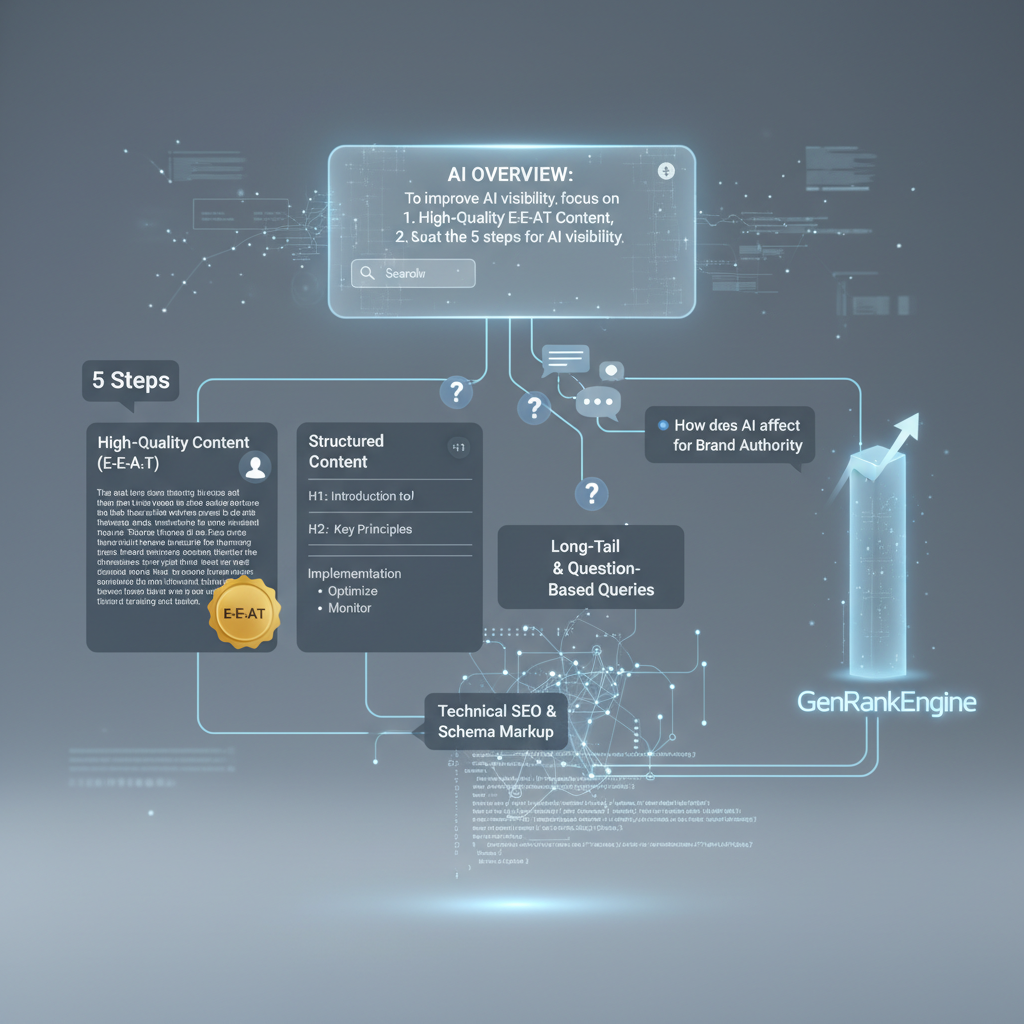
Google AI Overviews don’t rank pages — they assemble answers. Here’s how to ensure your product is extractable, citable, and recommended in the AI search era.

Introduction
Google AI Overviews mark a structural break in how search works.
They don’t rank pages. They assemble answers.
When a user asks Google a question today, the system is no longer choosing a “best result.” Instead, an AI agent retrieves fragments from multiple sources, synthesizes them, and presents a unified snapshot at the top of the page.
This creates a new problem for founders and marketers:
If your product cannot be correctly extracted, it cannot be recommended.
Traditional SEO focuses on visibility to humans. AI Overviews demand something different: visibility to agents. This post breaks down the five concrete steps required to make your content readable, extractable, and citable inside Google AI Overviews — and why most sites fail this without realizing it.
1. Understanding Google AI Overviews: The New Search Reality
Google AI Overviews are AI-generated summaries that appear directly at the top of the search results. Their goal is not discovery — it is resolution.
Instead of sending users to ten blue links, Google’s AI:
- Retrieves content from multiple sources
- Extracts relevant entities, claims, and facts
- Synthesizes a single answer
- Attributes sources only if they survive extraction
This system is powered by large language models using retrieval-augmented generation (RAG). Unlike featured snippets, AI Overviews do not quote a single page. They assemble an answer across pages.
That distinction matters.
If your pricing, differentiation, or positioning is unclear to an AI agent, the model will either:
- ignore it, or
- hallucinate a replacement using competitor content
This is why many brands see competitors recommended even when their pages rank higher.
2. The Foundation: High-Quality, Authoritative, and User-Centric Content (E-E-A-T)
E-E-A-T still matters — but not in the way most people think.
In AI Overviews, E-E-A-T is not a checklist. It’s a filter. Content that fails basic trust signals never enters the extraction stage.
What works consistently:
Answer intent immediately
AI systems favor pages that lead with a direct answer in the first 1–2 sentences after a heading.Be explicit, not clever
Metaphors, marketing copy, and “storytelling” often collapse under extraction. Plain language survives.Anchor claims clearly
Vague positioning (“best-in-class”, “modern”, “powerful”) is ignored. Specific claims (“tracks weekly AI citations across ChatGPT and Gemini”) are not.
At scale, AI systems reward clarity over creativity.
3. Structure for AI Comprehension: Make Your Content Extractable
Most websites are designed to be read. Very few are designed to be parsed.
AI Overviews rely on clean structural signals to identify what matters. Without them, important information disappears.
What consistently improves extraction accuracy:
Strict heading hierarchy
H1 → H2 → H3 should form a logical outline, not a visual one.Question-based subheadings
AI Overviews are triggered by questions. Pages that mirror that structure are easier to assemble.Lists over paragraphs
Bulleted facts survive extraction far more reliably than dense prose.
A critical insight most teams miss
When we simulate agentic crawls, we often see this pattern:
Humans understand the page.
AI extracts the wrong thing.
Pricing tiers get merged. Features lose ownership. Competitors receive credit for your claims.
This isn’t a ranking problem. It’s an extraction failure.
4. Targeting AI Queries: Optimize for Assembly, Not Keywords
AI Overviews appear most often for:
- “How does X work?”
- “What is the difference between X and Y?”
- “Best tools for…”
These are not keyword queries. They are decision queries.
To win them:
Target specific questions, not broad terms
AI prefers pages that answer one thing exceptionally well.Build topic clusters, not isolated posts
Depth signals authority. Authority increases citation probability.Anticipate the next question
AI Overviews reward pages that resolve the user’s entire decision chain, not just the initial query.
The goal is not traffic.
The goal is inclusion in the assembled answer.
5. Technical SEO and Trust Signals: Help the Agent Help You
Technical SEO still matters — but now it serves a different master.
AI agents rely on technical signals to interpret content, not just index it.
Key levers that consistently help:
Structured data (Schema)
FAQ, HowTo, and Article schema reduce ambiguity during extraction.Fast, clean pages
Slow or bloated pages lose extraction fidelity.Internal linking with intent
Links tell the agent which pages define the topic and which are supporting evidence.
The missing step: validate extraction
Most teams ship content and hope it “works.”
A better approach:
- Strip your page to raw text
- Feed it to a language model
- Ask it to extract a specific claim (pricing, differentiation, audience)
- If it fails or hallucinates — the page is broken for AI
This is the core shift from SEO to Agentic Optimization.
Conclusion
Google AI Overviews represent a fundamental change in search behavior.
The future buyer is not a human scrolling results. It is an AI agent compiling answers.
If your content cannot be clearly extracted, it cannot be cited. If it cannot be cited, it cannot influence decisions.
Winning in AI search requires treating your site less like a brochure and more like a database: explicit, structured, and unambiguous.
The brands that adapt early won’t just survive this shift — they’ll become the default answers.
Want to know if AI agents can actually read your site?
Run an Agentic Visibility Scan and find out what’s being extracted — and what’s being lost.