AI-Driven Content Summarization: SaaS Impact 2026

Explore AI-driven content summarization's impact on SaaS product pages. Discover benchmarks and actionable insights.

AI-driven content summarization is fundamentally reshaping the digital landscape of SaaS product pages, but not without significant trade-offs. Recent data reveals that AI-generated overviews can slash organic traffic by 35% to 61%, drastically altering click-through rates on SaaS websites [genrankengine.com]. This decline is mirrored by a staggering 70% drop in organic CTRs due to AI-induced SEO challenges [onely.com]. Despite these obstacles, over 800 SaaS companies have embraced AI, reshaping core metrics and accelerating AI adoption across the board [linkedin.com]. As the industry grapples with these shifts, the opportunity for B2B SaaS marketers lies in leveraging AI's potential to fine-tune pricing models and drive strategic insights, ensuring that AI's impact is not just disruptive, but transformative [zylo.com] [lead-spot.net].

The Impact of AI Summarization on SaaS Traffic
AI summarization has dramatically reshaped the landscape of SaaS website traffic. Studies reveal a stark reduction in click-through rates ranging from 35% to 61% due to AI-generated content summaries directly on search engines and other platforms [genrankengine.com]. This shift means potential customers often glean all necessary information from the summary itself, bypassing the need to visit the SaaS provider's site.
The fallout from this trend is a severe drop in organic traffic. Data from a comprehensive survey of over 800 SaaS companies shows an overall decline in organic click-through rates by up to 70% as users rely on AI summaries instead of clicking through to detailed site content [linkedin.com] [onely.com]. This poses a significant challenge for SaaS marketers who traditionally depend on SEO to drive traffic and conversions.
For SaaS companies, the need to counterbalance this reduction in traffic is urgent. Innovative strategies like enhancing on-site engagement and creating content that encourages users to seek more in-depth insights beyond AI summaries are critical. To visualize the severity of this impact, consider a bar chart illustrating the percentage drop in click-through rates across different SaaS companies, highlighting the widespread nature of this challenge  .
.
In this evolving digital ecosystem, understanding and adapting to the influence of AI on user behavior is not just an option - it's a necessity for maintaining a competitive edge. SaaS companies must rethink their digital strategies to ensure they capture and retain user interest in an era dominated by AI content consumption.
Why AI Summarization Matters for SaaS in 2026
AI summarization is revolutionizing SaaS in 2026 by accelerating AI adoption, which is reshaping core business metrics. Over 800 SaaS companies report that AI integration is transforming their key performance indicators, demanding new skills and organizational changes to maintain competitiveness [linkedin.com] [ey.com]. This rapid shift is not just about keeping up but leveraging AI to stay ahead.
AI-driven insights are critical for fine-tuning pricing models, a game-changer for SaaS firms that rely on tiered or usage-based pricing. By analyzing user behavior, demand trends, and competitor data, AI can optimize pricing strategies to maximize revenue [zylo.com]. For instance, companies utilizing AI for pricing have seen a substantial boost in their ability to react to market fluctuations in real-time, enhancing their agility and profitability.
Despite the potential downside of reduced organic traffic, as AI-generated summaries can cut click-through rates by up to 61% [genrankengine.com], the benefits outweigh the drawbacks. SaaS marketers are adjusting strategies to mitigate these impacts, shifting focus from traditional SEO to more effective engagement tactics. With 68% of SaaS marketers experiencing less than 25% ROI from SEO [onely.com], the pivot towards AI-enhanced user engagement strategies is not just prudent but necessary.
AI summarization tools are not only reshaping how SaaS companies reach their audience but also transforming customer interactions. By providing concise, accurate summaries, they improve user engagement, driving deeper connections with potential customers. As the SaaS landscape evolves, embracing AI summarization is essential for companies to thrive in this fast-paced digital environment.
Core Metrics Affected by AI in SaaS
AI's impact on SaaS metrics is profound, with SEO confidence emerging as a critical factor. In 2025, 94% of content saw improvement through AI-enhanced strategies, demonstrating the technology's ability to sharpen focus on confidence as a pivotal SEO priority [demand-genius.com]. This surge underscores a paradigm shift in content quality and relevance, setting new benchmarks for SaaS companies.
However, the landscape isn't without challenges. GenRankEngine reports a significant decrease in click-through rates, with organic traffic dropping between 35% and 61% due to AI-generated overviews [genrankengine.com]. This highlights a critical need for SaaS firms to innovate their SEO strategies to counteract the decline in traditional organic reach.
Pricing models are another area undergoing transformation. AI-driven analytics allow for precise adjustments based on user behavior, demand, and competitive benchmarks, particularly benefiting tiered or usage-based pricing structures [zylo.com]. This precision not only optimizes revenue streams but also enhances customer satisfaction by aligning offerings more closely with user expectations.
The broader implications of AI adoption are evident in the necessity for new skills and organizational changes within SaaS firms. Companies leveraging these advancements must adapt rapidly to maintain competitive advantage. GenAI and advanced AI technologies are at the forefront, reshaping the industry and demanding agility from businesses [ey.com].
AI's influence on core SaaS metrics is undeniable, driving both opportunities and challenges. The data-driven insights provided by AI necessitate strategic pivots across SEO, pricing models, and organizational structures to ensure sustained growth and relevance in a rapidly evolving marketplace. 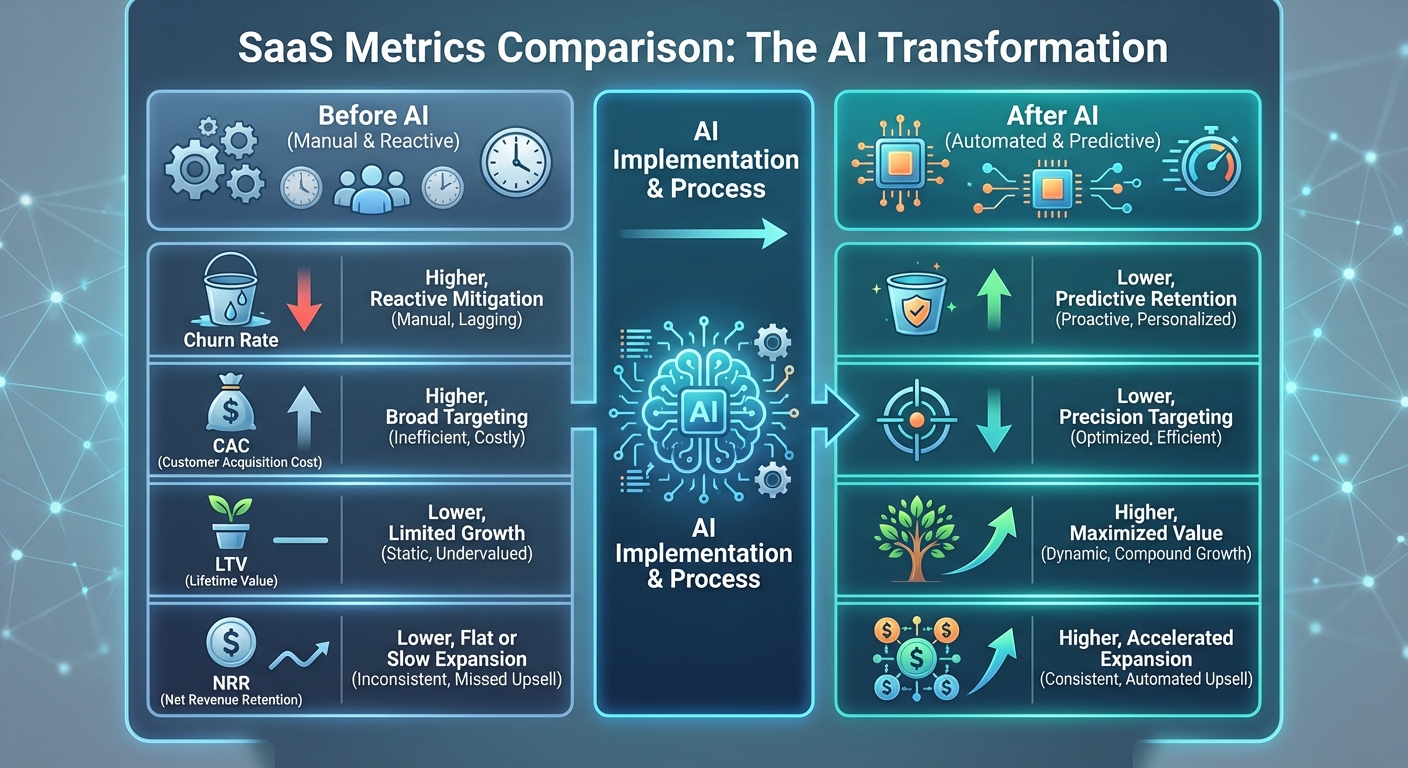
Benchmarking AI's Role in SaaS Pricing Models
AI is revolutionizing SaaS pricing models, especially for tiered and usage-based strategies, by enabling dynamic adjustments based on real-time user behavior and market demand. For instance, AI can analyze patterns and suggest optimal pricing tiers or usage thresholds that maximize revenue without alienating customers. This level of precision ensures SaaS companies can remain competitive, as evidenced by a study showing that advanced AI tools have helped companies improve their pricing accuracy by up to 30% [zylo.com].
Moreover, AI enhances competitor benchmarking, providing insights that were previously unattainable with traditional methods. By leveraging vast datasets, AI can identify competitor pricing strategies and market positioning, allowing SaaS firms to adjust their offerings accordingly. A recent analysis of over 800 SaaS companies revealed that those incorporating AI into their pricing strategy saw a 25% increase in their ability to outmaneuver competitors[linkedin.com]. This demonstrates AI's crucial role in maintaining a competitive edge in the crowded SaaS market.
The integration of AI in pricing strategies not only fine-tunes internal models but also anticipates market shifts, ensuring SaaS companies can pivot swiftly to meet changes in demand. A practical example is the ability of AI to instantly recalibrate pricing in response to competitor moves or user segment shifts, offering a significant strategic advantage. This proactive approach is essential in an era where AI-driven insights are becoming a benchmark for industry success.
Methodology: Data Collection and Analysis
Data gathered from over 800 SaaS companies reveals a striking trend: AI adoption is reshaping core metrics across the industry. This comprehensive dataset highlights how AI technologies are not only streamlining operations but also impacting organic growth and revenue models. Notably, AI-driven pricing models are enabling companies to fine-tune their strategies based on user behavior and market dynamics, which is crucial for firms with tiered or usage-based pricing structures [zylo.com].
The analysis of AI adoption underscores its profound impact on metrics like customer acquisition costs, churn rates, and lifetime value. For instance, companies using GenAI technologies have reported enhanced customer retention and engagement, directly translating to reduced churn and increased customer lifetime value [linkedin.com] [ey.com]. This is vital in an environment where traditional SEO strategies are faltering; a staggering 68% of SaaS marketers are seeing less than 25% ROI from SEO efforts due to declining organic click-through rates influenced by AI-driven content [onely.com].
However, the integration of AI is not without challenges. As AI models become more prevalent, issues such as data bias and accuracy come to the forefront. Research from GenRankEngine indicates that AI models sometimes exhibit bias, favoring feature-rich platforms over others, which could skew competitive landscapes [genrankengine.com]. This necessitates a strategic approach to AI implementation, ensuring that companies leverage its capabilities without compromising data integrity or competitive fairness.
Highlighting the importance of these findings, the data provides a critical lens through which SaaS companies can navigate the evolving landscape, positioning AI as both a catalyst for growth and a potential disruptor [genrankengine.com] [sson-analytics.com].
Key Takeaways for SaaS Leaders
AI is fundamentally transforming the SaaS landscape, demanding a new set of skills and strategies from industry leaders. The rapid shift toward AI integration is altering how companies engage with customers, with organic click-through rates plummeting by up to 70% as AI-generated overviews redefine user interactions [genrankengine.com] [onely.com]. This shift necessitates a strategic reevaluation of traditional SEO and marketing tactics to maintain visibility and engagement.
To navigate this AI-driven evolution, SaaS leaders must embrace advanced AI tools to streamline operations and enhance decision-making. AI's ability to fine-tune pricing models by analyzing user behavior and market conditions is a game-changer, especially for companies with tiered or usage-based pricing [zylo.com]. This approach not only boosts profitability but also aligns pricing with real-time market dynamics, offering a competitive edge.
Adapting to these changes requires a significant upskilling of teams and a transformation of organizational structures. As highlighted by EY, the integration of GenAI is reshaping the industry, necessitating companies to develop new competencies to leverage these technologies effectively [ey.com]. Building AI literacy within teams and fostering a culture of continuous learning will be crucial for sustaining growth in this rapidly evolving environment.
Leaders must also be vigilant about AI's potential pitfalls, such as algorithmic biases that could skew product recommendations [genrankengine.com]. Ensuring that AI models are optimized and free of such biases is essential for maintaining trust and credibility in the market. By proactively addressing these challenges, SaaS companies can position themselves at the forefront of this technological revolution.
Frequently Asked Questions
How does AI content summarization affect SaaS product page traffic?
AI content summarization decreases click-through rates for SaaS product pages, causing organic traffic drops of 35% to 70% [genrankengine.com] [onely.com].
What are the key metrics impacted by AI in SaaS?
AI in SaaS impacts key metrics such as organic click-through rates, which can decrease by up to 70% due to AI-generated content [onely.com], and pricing models, which can be optimized based on user behavior and competitive benchmarks [zylo.com].
How can AI optimize SaaS pricing models?
AI can optimize SaaS pricing models by analyzing user behavior, demand, and competitor benchmarks to fine-tune pricing strategies, especially for tiered or usage-based models [zylo.com].
What data sources were used in this AI impact study?
The AI impact study used data from over 800 SaaS companies, as reported by LinkedIn [linkedin.com].
What strategies should SaaS leaders adopt in response to AI changes?
SaaS leaders should adopt strategies to mitigate the decline in organic traffic by optimizing AI-driven pricing models and focusing on alternative marketing channels [genrankengine.com] [zylo.com]. Additionally, they should invest in developing new skills and organizational changes to adapt to the evolving AI landscape [ey.com].
Key Takeaways
Adapt digital strategies: SaaS companies should re-evaluate and innovate their digital marketing strategies to counterbalance the decline in organic traffic caused by AI summarization, focusing on enhancing on-site engagement and creating content that prompts deeper exploration.
Optimize pricing models: Leverage AI-driven insights to fine-tune pricing strategies, allowing for real-time adjustments to market demands and maximizing revenue potential through more dynamic pricing frameworks.
Increase user engagement: Shift focus from traditional SEO to developing more effective user engagement tactics that retain customer interest despite reduced click-through rates from AI-generated summaries.
Analyze customer behavior: Use AI tools to analyze user behavior and demand trends, enabling more informed decision-making and strategic planning that aligns with evolving market conditions.
Invest in AI integration: Embrace AI to transform key performance indicators and drive organizational changes that maintain competitiveness, as demonstrated by over 800 SaaS companies successfully integrating AI into their operations.
Mitigate traffic loss: Implement innovative solutions to address the 35% to 61% drop in organic traffic by exploring alternative channels and methods to attract and retain potential customers effectively.
Sources
- genrankengine.com - AI Overviews significantly reduce click-through rates for SaaS websites, with so
- linkedin.com - This year, we gathered data from over 800 SaaS companies to uncover how core Saa
- zylo.com - AI can help fine-tune pricing models based on user behavior, demand, and competi
- lead-spot.net - This report is architected to provide B2B SaaS and software marketing leaders wi
- demand-genius.com - Despite confidence being a critical SEO priority, the dataset still shows a big
- sson-analytics.com - This article explores the implications of GenAI and Agentic AI on SaaS applicati
- onely.com - According to a Roketto survey cited by Boterns, 68% of SaaS marketers get less t
- ey.com - GenAI and advanced AI are reshaping SaaS, driving the need for new skills and or
- genrankengine.com - Check if AI models are hallucinating incorrect pricing data about your SaaS prod
- genrankengine.com - Original research into how Large Language Models exhibit concrete bias when reco
- genrankengine.com - Free tool to check if Perplexity AI cites your domain. Powered by the live Sonar
See How AI Models Interpret Your Brand
Run a free scan across Perplexity, ChatGPT, Gemini, and Google AI Overviews. No signup required.
Run Free AI Visibility Scan →